Blog ·
A third of Overture places we checked had closed
Overture Maps publishes tens of millions of places, free to use, and Mapricot's place search uses them alongside OpenStreetMap. Last month, while testing them, I kept finding shops and restaurants in San Francisco and Chicago that had closed. So I checked properly: every named place in Overture's November release, in 31 cities in eight countries, against official registers that keep a business on file after it closes.
In the median city, 32% of the Overture places a register could check had closed, about a third. OpenStreetMap's venues, put through the same check in the same cities, came out at 19%. Most of these aren't recent closures that no one has caught up with yet: in the cities whose registers give a date, 29% of Overture's checked places had closed more than a year before the release.
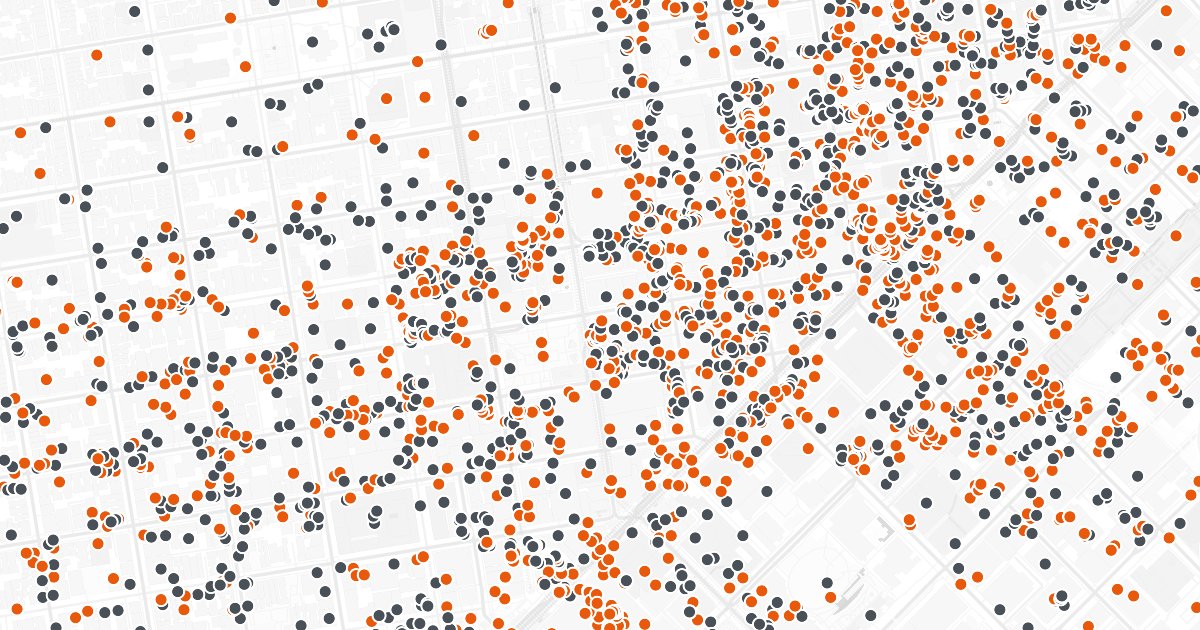
On the map above, each dot is a place in Overture's data in downtown San Francisco that the city's business register knows. The orange ones had closed before the release came out.
How I checked
Many cities publish their business licences, and France, Brazil, and Singapore publish national company registers. The useful ones keep a business after it closes, with the date it closed. I used one for each city:
- United States: business licences or registered locations in San Francisco, Chicago, Philadelphia, and Washington, DC, and New York's licences for trades like tobacco, electronics, and laundries.
- Canada: Vancouver's and Toronto's business licences.
- France: INSEE's register of every business premises (SIRENE), in 12 cities.
- Mexico: INEGI's business directory, comparing November 2019 with May 2026, in four cities.
- Brazil: the Receita Federal's register of company premises (CNPJ), in six cities.
- Singapore: ACRA's register of companies.
- Melbourne: the City of Melbourne's census of every business in its center.
Then for each city:
- I took every named place in Overture's 2026-11-18 release inside the city, and every named shop, restaurant, office, and other venue in OpenStreetMap.
- A place matches a register entry with the same name within 150 meters, ignoring word order, accents, punctuation, and legal forms like Inc or SARL. Where a register has postcodes but no points, it matches in the same postcode.
- A matched place has closed if every entry it matches had closed by 18 November 2026, when the release came out. A place that matches a closed entry and an open one, like a shop that changed owners, counts as open.
Only places that match a register are counted. That's about a third of the places in French cities, where SIRENE lists nearly every business, and as few as 1% in New York, whose register covers only a few trades. The share closed is of those matched places.
Registers differ, and that's why OpenStreetMap goes through the same check. A register that's slow to record openings, or quick to record closures, or a matching rule that picks odd places, would push OpenStreetMap's share up just as much as Overture's. So the gap between them in a city means more than either number alone. Vancouver shows why: its open data only goes back to 2024, so few closures show up there for either.
Averaged over the cities, each counting once, 30% of Overture's checked places had closed (95% interval 27–34%), against 20% of OpenStreetMap's (17–22%). A looser name match, which also counts names that share most of their words, gives medians of 29% and 16%.
The scripts and the results are here, with every number in results.json. The README says how to rerun the whole check, which takes about two hours, most of it downloading.
By city
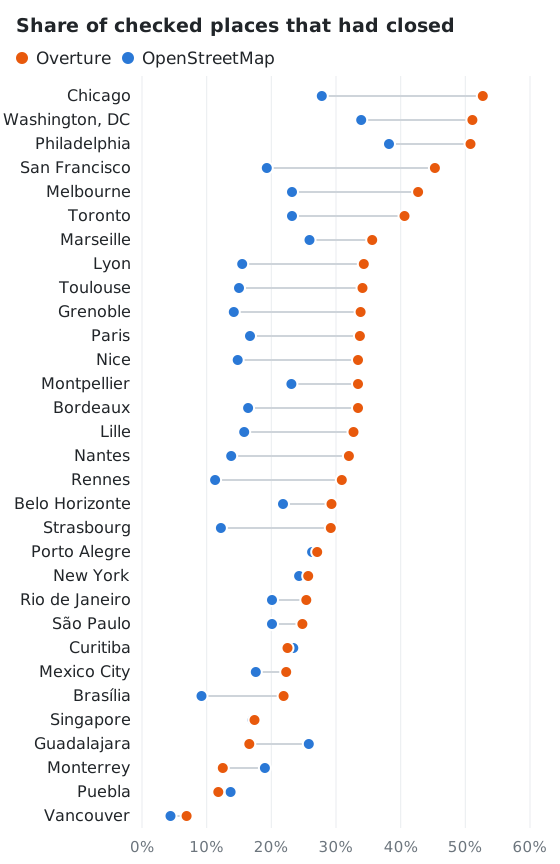
Overture's share is clearly higher than OpenStreetMap's in 24 of the 31 cities, by 13 points in the median city, and in France it's often double. In the other seven, Guadalajara, Monterrey, Puebla, Curitiba, Porto Alegre, New York, and Singapore, the two are about level, or OpenStreetMap's is higher.
By source
Overture merges places from several companies. In this release each place comes from one of them, and Meta supplies about seven in ten, so the share closed can be split by source:
| Places | Median city | Range across cities |
|---|---|---|
| From Foursquare | 55% | 20–89% |
| From BrightQuery | 35% | 30–65% |
| From Microsoft | 28% | 9–71% |
| From Meta, with no status | 27% | 5–71% |
| From Meta, marked open | 27% | 2–39% |
| From smaller sources | 15% | 4–32% |
| Overture's confidence 0.7 or more | 29% | 7–50% |
| Marked permanently closed by Overture | 75% | 60–95% |
| OpenStreetMap | 19% | 4–38% |
Foursquare's places are the stalest: in the median city, more than half had closed. Meta's are better, but still well above OpenStreetMap.
Can the registers be trusted?
A register can be wrong too, or record a closure that a new owner then reopens under the same name. So I checked one register against another. Chicago's health department inspects restaurants and food shops, and records when an inspector finds one out of business. Its business licences come from a different department. On the 7,734 places both can check, they agree on 90%, and 91% of the places the licences call closed also had an out-of-business last inspection.
I also looked up a few closed places by hand. That mostly showed how hard it is to tell from the web: listings rarely say a place has closed, which is the problem this whole check is about.
If you use Overture's places
- Keep dropping places marked closed. When Overture marks a place permanently closed, the register agrees three times out of four. But it marks only 2% of places that way, so that filter alone doesn't go far.
- Don't read "open" as open. Meta's places that Overture marks open had closed as often as those with no status at all, 27% in the median city.
- Don't count on the confidence score. Keeping only places at 0.7 or more lowers the median from 32% to 29%.
- Look at the sources. A place whose only source is Foursquare is about twice as likely to have closed as one from Meta.
- Check against a register where you can. Every register here is open data, and a place that matches a closed entry and no open one is a good candidate to drop.
Caveats
- It's about a third of the places a register could check, not of every Overture place. Matched places lean towards registered storefronts. The rest may be open, closed, or never real.
- Registers record legal names, which can differ from what's on the sign, and their points are geocoded addresses.
- A closed place isn't useless. Its name and address can still help geocode an address. But it's a wrong answer to "coffee near me".
What Mapricot does about it
Mapricot already leaves out the places Overture marks closed, and those whose only source is Foursquare or Microsoft, after a smaller check in San Francisco and Chicago last month. Even so, in the median city, 30% of the Overture places Mapricot serves that a register could check had closed. So there's more to do, and I'm looking at what else can tell an open place from a closed one.
Overture is still the best open source of places in a lot of the world, especially where OpenStreetMap is thin. If you work on Overture or use it, I'd love to compare notes at support@mapricot.com.